
You don't smoke. You never have. So why does your chest X-ray suddenly show something you never expected?
This is a question more people are asking every year. Lung cancer has always been linked to cigarettes. But that link is starting to blur. A growing number of patients who walk into oncology clinics have never touched a cigarette in their life.
If you live in a city like Gurugram, where smog, traffic fumes, and dusty construction sites are part of daily life, this should worry you a little. Not to scare you, but to make you aware. Awareness is what catches cancer early, when it is most treatable.
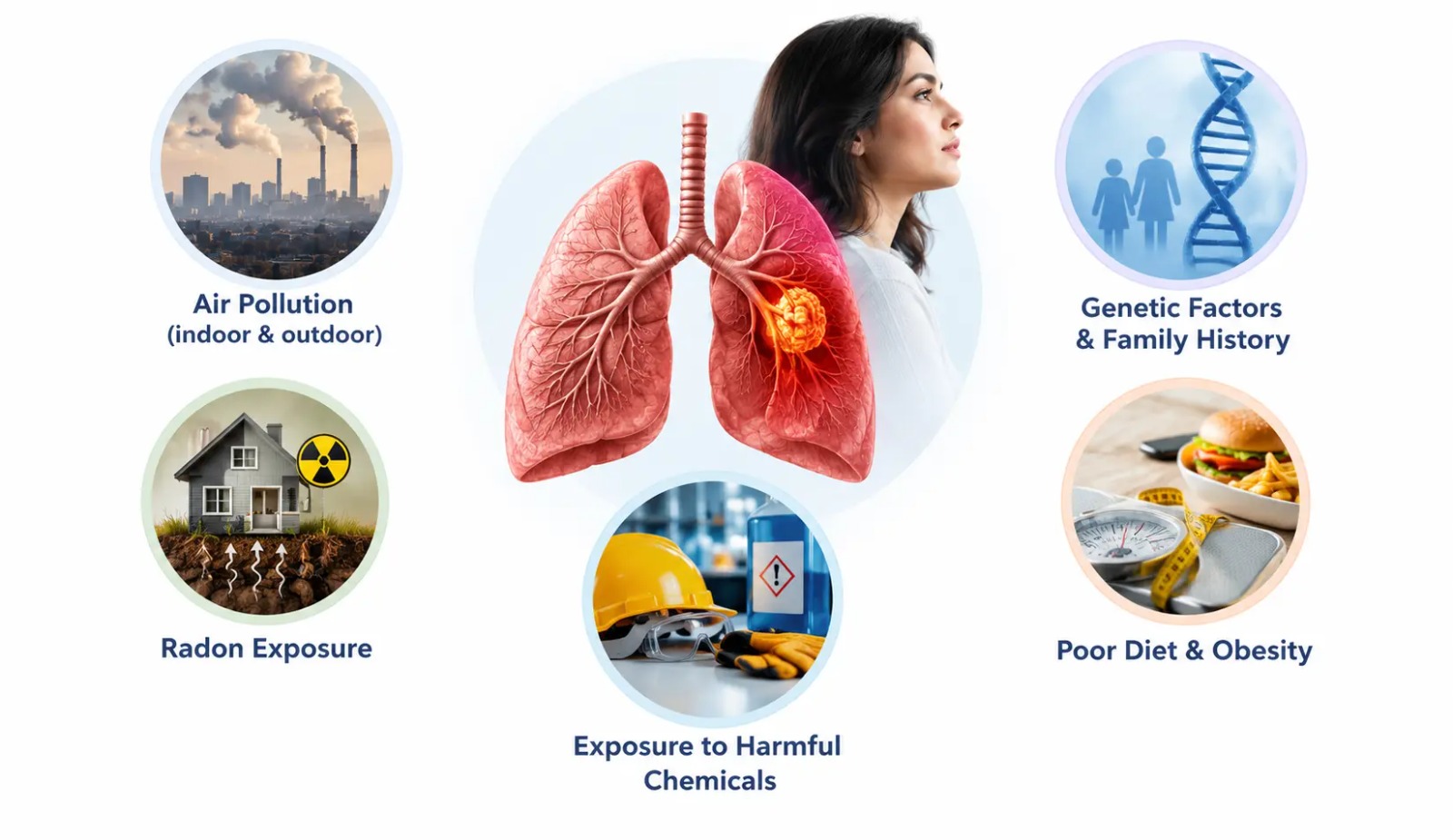
Let's look at five real, research-backed causes of lung cancer in people who have never smoked.
Many people believe lung cancer only happens to smokers. That belief is outdated.
Studies show that a meaningful share of lung cancer cases now occur in people who never smoked. In fact, lung cancer in non-smokers is being studied as almost its own category of disease, with different patterns, different genetics, and often a slower spread.
The problem is that non-smokers rarely think they are at risk. So they ignore early symptoms like a lingering cough or breathlessness. That delay can cost valuable time.
Here are the five causes every non-smoker should know.
Radon is a radioactive gas you cannot see, smell, or taste. It forms naturally in soil and can seep into homes through cracks in the floor, walls, or foundation.
Over years, breathing in radon can damage the cells lining your lungs. Health bodies around the world rank radon as the leading cause of lung cancer in people who have never smoked.
What makes radon dangerous is that it builds up quietly indoors, especially in closed, poorly ventilated spaces. You could be exposed for years without any warning sign.
What you can do:
You don't need to smoke to absorb the harm of smoking. Secondhand smoke, the smoke you breathe in from someone else's cigarette, carries many of the same cancer-causing chemicals as direct smoking.
Less talked about is thirdhand smoke. This is the residue that settles on clothes, curtains, car seats, and furniture long after a cigarette is put out. Children and partners living with smokers absorb this residue daily, often without realising it.
If you regularly spend time around smokers, at home, in a car, or in a small office, your lungs are quietly absorbing risk, even though you never lit a cigarette yourself.
What you can do:
This cause hits close to home for anyone living in Delhi-NCR. Fine particulate matter from vehicle exhaust, construction dust, and industrial emissions is now recognised as a real and growing cause of lung cancer, even in people who have never smoked a day in their life.
These particles are so small that they bypass your body's natural filters and settle deep inside your lungs. Over years of exposure, this can trigger the same kind of cellular damage that smoking causes.
Winters in North India, when smog levels spike, are a particularly high-risk period. Even short daily commutes without a mask can add up over time.
What you can do:
Certain jobs quietly increase lung cancer risk, regardless of whether the person smokes. This includes exposure to:
Workers in construction, factories, mining, and transport are more exposed than most people realise. Symptoms can take decades to appear, which makes this cause especially easy to overlook.
What you can do:
Some lung cancers in non-smokers have nothing to do with the environment at all. They are driven by specific gene mutations, such as changes in the EGFR gene, that cause lung cells to grow abnormally.
Interestingly, this type of lung cancer is more common in non-smoking women and tends to respond differently to treatment compared to smoking-related lung cancer.
Family history also plays a role. If a parent or sibling has had lung cancer, your own risk is somewhat higher, even if you have never smoked.
What you can do:
Because non-smokers don't expect to get lung cancer, symptoms often get brushed aside as a cold, allergies, or stress. Please don't ignore:
Catching these signs early, and acting on them, is often the difference between a simple treatment and a complicated one.
If you've been experiencing any of the symptoms above, or you know you've had long-term exposure to any of these five causes, don't wait it out.
Getting checked by a cancer specialist in Gurugram can help you catch warning signs early, long before they turn into something serious. An experienced oncologist like Dr. Pooja Gupta can guide you through the right screening tests, interpret your results clearly, and build a treatment plan suited to your exact situation, not a generic one.
Early consultation is not about panic. It's about peace of mind, and catching problems while they are still easy to treat.
If something feels off, book a consultation with Dr. Pooja Gupta today. A short appointment now could save you months of worry later.
